Software Development

Software Testing Strategies: How to Build Reliable Software in 2026

Discover the most effective software testing strategies for building reliable, secure, and scalable applications. Learn how risk-based testing, automation, continuous testing, and modern QA practices help teams reduce bugs, accelerate releases, and improve software quality.

July 24, 2026

Software Testing Strategies: How to Build Reliable Software in 2026

Software quality has never been more important. Modern applications are released faster than ever, often multiple times per day, making traditional testing approaches insufficient. A well-defined software testing strategy helps organizations deliver reliable software, reduce production bugs, improve customer satisfaction, and accelerate development.

Whether you're building a SaaS platform, an enterprise application, or a custom business solution, choosing the right testing strategy is essential for long-term success. Modern teams increasingly integrate testing throughout the development lifecycle using Agile, DevOps, and CI/CD practices rather than treating it as a final phase.

What Is a Software Testing Strategy?

A software testing strategy is the high-level plan that defines:

  • What should be tested
  • When testing should occur
  • Which testing techniques should be used
  • Who is responsible for each testing activity
  • Which tools and environments are required
  • How quality will be measured

Unlike a test plan, which focuses on a specific project or release, the testing strategy defines the overall quality approach adopted by an organization.


Why Your Business Needs a Testing Strategy

Without a structured testing process, software teams often experience:

  • Bugs reaching production
  • Unexpected downtime
  • Security vulnerabilities
  • Slower releases
  • Increased maintenance costs
  • Poor user experience

A good strategy allows teams to detect issues earlier, when they are significantly cheaper and easier to fix.


The Main Software Testing Strategies

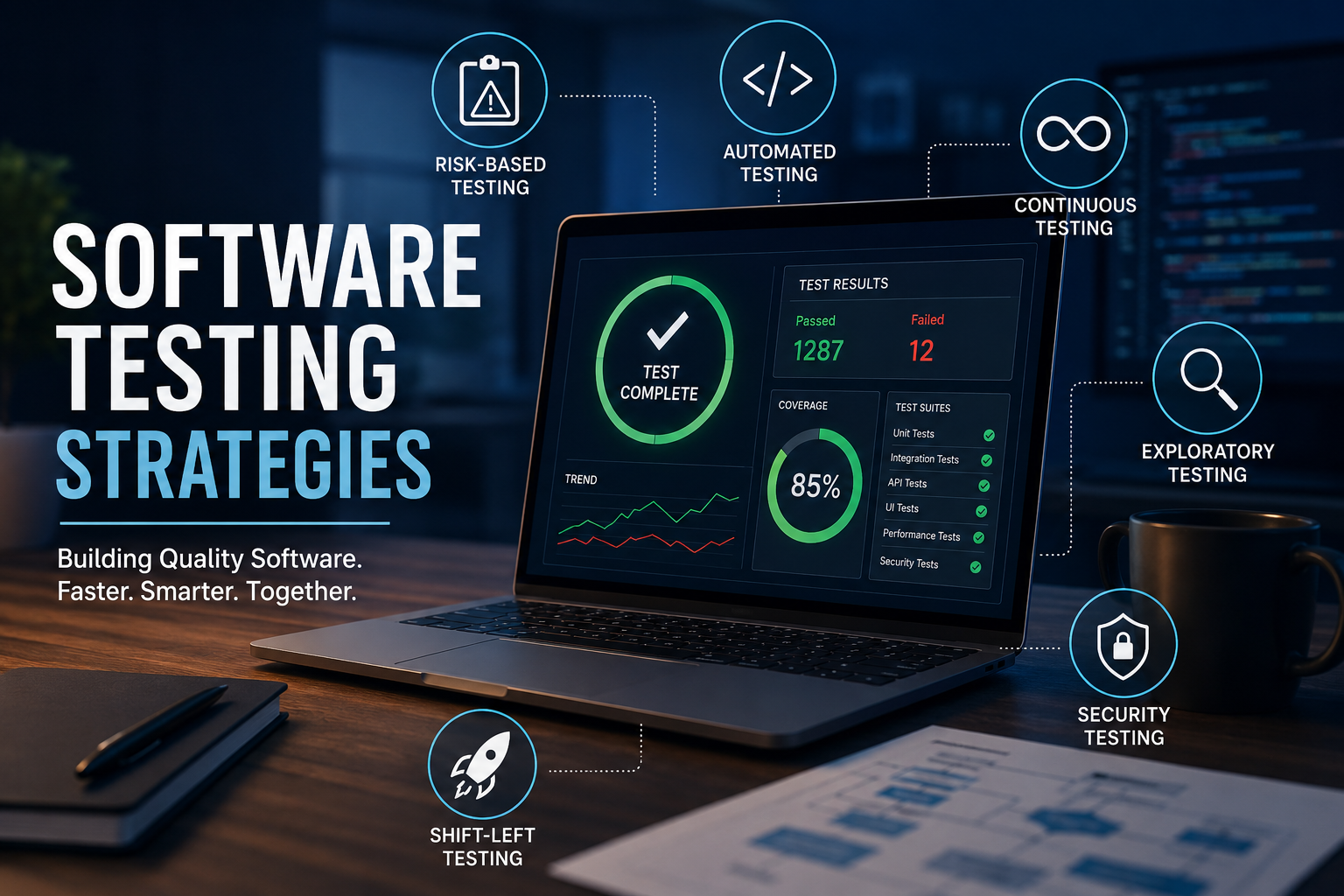
1. Risk-Based Testing

Risk-based testing prioritizes testing efforts according to business impact and technical risk.

Critical components such as:

  • authentication
  • payment systems
  • financial transactions
  • customer data

receive significantly more testing than low-risk features.

This approach maximizes quality while keeping testing costs under control.

Best for:

  • Enterprise software
  • Banking
  • Healthcare
  • eCommerce

2. Shift-Left Testing

Shift-left testing moves quality assurance earlier in the software development lifecycle.

Instead of waiting until development is complete, testing starts during:

  • requirements analysis
  • architecture design
  • implementation
  • code review

This dramatically reduces the number of defects discovered late in the project.


3. Test Automation Strategy

Manual testing alone cannot support modern continuous delivery pipelines.

Automation is typically used for:

  • regression testing
  • API testing
  • integration testing
  • smoke testing
  • end-to-end testing

Popular tools include:

  • Playwright
  • Cypress
  • Selenium
  • JUnit
  • Pytest

Automation allows hundreds or even thousands of tests to execute after every code change.


4. Exploratory Testing

Not every bug can be found by automated scripts.

Exploratory testing relies on experienced QA engineers investigating the application without predefined test cases.

This approach is particularly effective for discovering:

  • usability issues
  • unexpected edge cases
  • workflow problems
  • inconsistent behaviors

5. Continuous Testing

Continuous Testing integrates automated quality checks directly into CI/CD pipelines.

Every commit automatically triggers:

  • unit tests
  • integration tests
  • security scans
  • performance validation
  • code quality analysis

This enables rapid feedback and safer deployments.


Essential Types of Software Testing

An effective strategy usually combines multiple testing approaches.

Unit Testing

A quick conversation

Facing a similar challenge?

Tell us about your context: in a call we'll figure out together if and how we can help, no strings attached.

Verifies individual functions or classes.

Fast, inexpensive, and ideal for catching coding errors early.


Integration Testing

Ensures different software components communicate correctly.

Examples include:

  • APIs
  • databases
  • external services
  • payment gateways

System Testing

Validates the complete application as a whole.


Regression Testing

Ensures that new features do not break existing functionality.

This becomes increasingly important as software evolves.


Performance Testing

Measures:

  • response time
  • scalability
  • throughput
  • resource consumption

Common tools include JMeter, k6, and Gatling.


Security Testing

Identifies vulnerabilities before attackers do.

Typical assessments include:

  • authentication
  • authorization
  • injection attacks
  • API security
  • encryption validation

How AI Is Changing Software Testing

Artificial intelligence is rapidly transforming software quality assurance.

Modern AI-assisted testing platforms can:

  • generate test cases automatically
  • identify missing test coverage
  • detect visual regressions
  • repair broken UI selectors
  • prioritize regression suites based on recent code changes

However, AI complements rather than replaces experienced QA engineers. Human expertise remains essential for exploratory testing, business validation, and risk assessment.


Best Practices for an Effective Testing Strategy

Successful software teams typically follow these principles:

  • Automate repetitive tests
  • Keep unit tests fast and reliable
  • Execute tests continuously through CI/CD
  • Prioritize high-risk functionality
  • Review testing metrics regularly
  • Include security testing from the beginning
  • Combine manual and automated testing
  • Continuously improve test coverage

Common Mistakes

Many organizations struggle because they:

  • rely only on manual testing
  • automate unstable tests
  • ignore performance testing
  • postpone testing until the end of development
  • focus exclusively on code coverage instead of business risk
  • neglect production monitoring

Avoiding these pitfalls significantly improves software reliability.


How Elsinor Helps Businesses Build Quality Software

At Elsinor, software quality is integrated into every development project.

Our engineering process includes:

  • automated testing
  • API validation
  • CI/CD integration
  • code reviews
  • performance optimization
  • security best practices
  • custom quality assurance workflows

Whether developing a new platform or modernizing an existing application, we help organizations reduce defects, accelerate releases, and deliver reliable software that scales with their business.


Conclusion

A modern software testing strategy is no longer optional. As software becomes increasingly complex and release cycles continue to accelerate, testing must evolve from a final verification step into an integral part of the entire development process.

Organizations that invest in structured testing strategies benefit from fewer production issues, faster deployments, lower maintenance costs, and greater customer trust. Combining automation, risk-based testing, continuous integration, and human expertise creates a sustainable quality assurance process capable of supporting modern software development.


Let's put it into practice

From ideas to systems that last.

If this article gave you something to act on, let's talk about applying it to your context: we design, build and manage tailored software and infrastructure, with ongoing accountability.